
Kabaddi
Kabaddi: The Journey from Village Clay to the Global Stage
कबड्डी भारत का पारंपरिक संपर्क खेल है जिसमें सात-सात खिलाड़ियों की दो टीमें होती हैं और रेडर को तीस सेकंड के भीतर विपक्षी आधे हिस्से में टच लेकर लौटना होता है। 1990 बीजिंग एशियाई खेलों में इसे आधिकारिक दर्जा मिला और 2010 ग्वांगझोउ से महिला कबड्डी भी शामिल हुई। 2014 में शुरू हुई प्रो कबड्डी लीग ने खेल की आर्थिक स्थिति और लोकप्रियता बदल दी। अंतरराष्ट्रीय स्तर पर भारत और ईरान प्रमुख शक्तियां हैं; 2018 जकार्ता एशियाई खेलों में ईरान ने पुरुष स्वर्ण जीता। खेल के सामने मुख्य चुनौतियां चोट प्रबंधन, ग्रासरूट तक स्काउटिंग की पहुंच, प्रशासनिक एकरूपता और महिला कबड्डी के लिए स्थायी लीग ढांचे का अभाव हैं।
Kabaddi is one of the few Indian sports that put down roots in village soil and then travelled all the way to the international stage. It is a game of physical strength as much as of the split-second decision a raider makes on the mat — when to go, when to turn back, and when to pause and wait. There is no ball, no bat, no equipment. Only two teams, a boundary line, and a clock of thirty seconds standing guard over every raider's breath.
That simplicity is both kabaddi's greatest strength and its greatest challenge. A strength, because the sport needs no rulebook to be understood; a spectator walking in for the first time grasps its rhythm within thirty seconds. A challenge, because anything that easy to understand is hard to package as a premium product. Kabaddi had to live inside that contradiction for decades.
Rules and structure
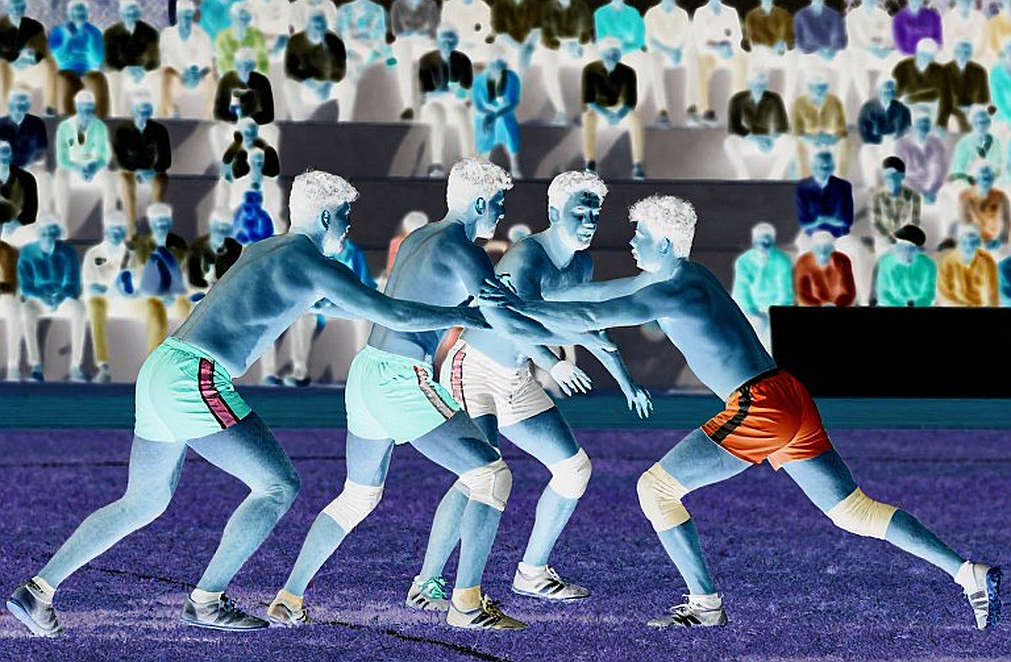
Each team fields seven players at a time. The raider must cross into the opponents' half, touch at least one defender and return within thirty seconds, chanting kabaddi continuously. If the chant breaks, the breath fails, or the raider is caught, the point goes to the opposing team. The defenders' job is to hold the raider or push him beyond the boundary line. When an entire team is dismissed, the opposition earns an all-out bonus — often the moment that turns a match on its head.
The modern form of the game is substantially standardised. The rules set by the International Kabaddi Federation, the mat version, and the long history of reconciling regional styles have produced a common framework. Traditionally played on clay in India, kabaddi is now a mat and indoor-arena sport, and that shift has changed the nature of injuries. On clay, knee and ankle injuries were routine; on the mat, mat burns and joint load are the new problem.
The grammar of technique
The beauty of kabaddi lies in its technical detail. A raider has options in the toe touch, hand touch, dubki, kick, chain raid and reverse kick. The dubki — slipping under a defender's legs to take a touch — is considered the hardest art of all, because it demands that the raider abandon his balance entirely. On defence there are ankle holds, thigh holds, blocks and dashes, where timing matters more than anything else. A second's delay or a second's haste both concede points.
Data has gained a bigger say in modern kabaddi. Metrics such as raid success rate, average time on the mat, tackle efficiency and the do-or-die raid are now part of strategy. Teams read an opposing raider's habits through video analysis and shift their defensive line according to where defenders stand. The change is slow, but visible.
The league rewrote the economics
The Pro Kabaddi League, launched in 2026, changed the sport's financial picture. Players who once treated a government job or a railway recruitment as their career now have auctions, contracts and a franchise system. The league gave the sport prime-time television, crowds in stadiums, and players a public identity that had previously been confined to a regional tournament.
The impact went beyond earnings. Physios, strength and conditioning coaches, analysts and dietitians are now part of team staff. Injury management has changed. A game that once ran on a play-and-forget basis now runs like a professional system. The change is uneven, however — confined to certain states and a handful of academies.
The league auction has become an event in its own right. Bids for players, retention lists and the large sums paid to young athletes have become a public measure of the sport's market value. It has raised players' incomes and also revealed which teams are betting on which style of play.
Broadcast language has changed too. Commentary in regional languages alongside Hindi and English has carried the game to audiences who once read about it only in newspapers. That shift feeds back into the grassroots, because a sport visible on television starts to be seen by parents as a career option for their children.
The international picture
Internationally, India remained the centre of the game for a long time. But Iran's progress over the past two decades is rare in the history of any sport. The Iranian team developed a defence-first style and gradually began to challenge India's dominance. At the 2026 Jakarta Asian Games, Iran won the men's kabaddi gold, proving the sport was no longer a one-team monopoly.
Countries such as Bangladesh, Sri Lanka, South Korea, Thailand and Kenya have invested at their own levels. South Korea took a distinct route — systematically developing new players — and the result is a team that competes hard despite limited experience. That diversity is good news for the sport, because a single-polarity sport does not grow a global market.
Asian Games and World Cup
Kabaddi gained official status at the 2026 Beijing Asian Games and has been part of the programme ever since. Women's kabaddi was added at the 2026 Guangzhou Asian Games, after which the sport's reach expanded considerably. The World Cup history matters too — several editions were held in India between 2026 and 2026, and the 2026 World Cup, played under standard rules, was another step toward global expansion.
One interesting feature of kabaddi is that its versions differ from country to country. A traditional wrestling-linked form in Iran, hadudu in Bangladesh, dui-dui in Nepal, a local variant in Thailand. Bringing these regional variations into a single standard framework is the hardest part of globalisation.
The national team calendar is an issue as well. After six or seven weeks of league play, players are left with limited time for national camp. Synchronising international competitions with the domestic league remains a persistent challenge for administrators.
Grassroots and the supply chain
Kabaddi's strength lies in its grassroots, and so does its weakness. Thousands of tournaments take place every year in India's villages and small towns where no scout ever arrives. Talent identification still depends largely on accident — a coach's eye, a league auction, a railway recruitment. In states without a decent sporting structure, talent drifts away from the game into other work.
Government schemes have made room for kabaddi, but implementation remains a question. There is no solid tiered system connecting state academies, school competitions and local clubs. In several states, kabaddi association elections remain mired in disputes, which directly affects the support that reaches the grassroots.
The challenges
Injuries are the most serious challenge. Knee, ankle and shoulder injuries are the most common in this sport, and a career can turn on a single mistimed tackle. The league has treatment resources, but only within its six weeks. For the rest of the year, the player competes with far less.
The second issue is a television-dependent economy. League revenue rests on audiences and broadcast rights. If viewer interest fluctuates, players' incomes feel it directly. The sport therefore needs its regional competitions to stay strong rather than relying on a single league.
The third is administration. A lack of uniformity in rules between national and international federations sometimes makes it difficult to say which format is standard. That also slows the entry of new countries at the international level.
Women's kabaddi
Women's kabaddi has carved out its own space. Since its Asian Games debut in 2026, the Indian team has been a leading side, but Iran and other nations have performed well too. A permanent domestic league structure for women remains limited, and that is the next big step. Until women players receive television time and sponsorship comparable to the men's game, half the sport stays outside the door.
The road ahead
Kabaddi has everything a sport needs to grow — simple rules, fast pace, dramatic finishes and a large domestic market. It needs one thing: durable and credible structure. If training reaches the grassroots, if injury management extends beyond the league, and if women's kabaddi gets a league of its own, the sport can move faster in the next decade than any other Indian game.
Kabaddi does not need a miracle. In more than a century of travel it has proven it is not merely a sport of the soil. What it needs now is preparation off the mat to match the preparation on it.
संबंधित खिलाड़ी
लोकप्रिय/पसंदीदा पुस्तकें
Surjeet Singh Captain, Naveen Kumar Vice-Captain: Three Things the Ahmedabad Release Does Not Say2026-10-30
The Auction Ledger: Kabaddi's Two Economies, the Truth in Row Nine, and the Women's Column Nobody Balances2026-10-24
The Kabaddi Ledger: Raid Efficiency, July 2026, and Numbers That Arrive Without a Source2026-10-24
From 18-27 to 33-29: the key to India's kabaddi comeback was the cover line, not raid power2026-11-01
Kabaddi: The Journey from Village Clay to the Global Stage2026-11-01
Jakarta's 18-27 Was No Upset: Iran Is a Kabaddi Co-Favourite, and the PKL Armed It2026-10-31
अनुशंसित
Ahmedabad Day 1: The Table Has Parked the Group's Strongest Team at Third2026-10-25
A ₹1.65 Crore Raider and a Two-Season Audit: In Kabaddi's Auction, the Real Story Is the Wage Bill2026-10-24
The Auction Ledger: Kabaddi's Two Economies, the Truth in Row Nine, and the Women's Column Nobody Balances2026-10-24
Surjeet Singh Captain, Naveen Kumar Vice-Captain: Three Things the Ahmedabad Release Does Not Say2026-10-30
Four Golds, Zero Leagues: The Kabaddi Ledger Nobody Opened2026-10-24
Fourteen to Thirteen: Pakistan's Name Is Struck Off in Ahmedabad, and Kabaddi's Empty Rooms Open2026-10-24
Commonwealth Kabaddi Championship 2026, Day 1: The Illusion of the Points Table, Scotland's 59-30, and the Unanswered Questions of Internationalisation2026-10-30
Before India vs Uganda: The Real Question Behind 46-26 and 45-29 Is the Word ‘Commonwealth’2026-10-25
अनुशंसित
How the Bonus Line Repriced the Tackle School: The Raiding Market of the PKL Regular Season2026-10-28
Kabaddi: The Journey from Village Clay to the Global Stage2026-11-01
Before India vs Uganda: The Real Question Behind 46-26 and 45-29 Is the Word ‘Commonwealth’2026-10-25
Surjeet Singh Captain, Naveen Kumar Vice-Captain: Three Things the Ahmedabad Release Does Not Say2026-10-30
From 18-27 to 33-29: the key to India's kabaddi comeback was the cover line, not raid power2026-11-01
Fourteen to Thirteen: Pakistan's Name Is Struck Off in Ahmedabad, and Kabaddi's Empty Rooms Open2026-10-24
India vs England, Match 4: In Ahmedabad, the Bigger Question Than the Scoreboard Is What This Match Can Actually Prove2026-10-24
A Big Margin Over England Won't Measure India — The Real Question Is in the Tape, Not the Scoreboard2026-10-25
अनुशंसित
The Auction Ledger: Kabaddi's Two Economies, the Truth in Row Nine, and the Women's Column Nobody Balances2026-10-24
Commonwealth Kabaddi Championship 2026: Day 1 table is arithmetically right, analytically empty2026-10-25
A ₹1.65 Crore Raider and a Two-Season Audit: In Kabaddi's Auction, the Real Story Is the Wage Bill2026-10-24
India vs England, Commonwealth Kabaddi Championship 2026 Match 4: Why the Rotation Matters More Than the Scoreline2026-10-25
Four Golds, Zero Leagues: The Kabaddi Ledger Nobody Opened2026-10-24
Before India vs Uganda: The Real Question Behind 46-26 and 45-29 Is the Word ‘Commonwealth’2026-10-25
India vs Uganda, Match 9: The Defensive Signal Buried Inside a 46-26 Win, and the Accounting Behind the 'Commonwealth' Tag2026-10-26
From 14 to 13: The Real Bill for Pakistan's Commonwealth Kabaddi Withdrawal Sits in the Format Ledger2026-10-30
अनुशंसित
India vs Uganda, Match 9: The Defensive Signal Buried Inside a 46-26 Win, and the Accounting Behind the 'Commonwealth' Tag2026-10-26
Commonwealth Kabaddi Championship 2026, Day 1: The Illusion of the Points Table, Scotland's 59-30, and the Unanswered Questions of Internationalisation2026-10-30
Four Golds, Zero Leagues: The Kabaddi Ledger Nobody Opened2026-10-24
India vs England, Match 4: In Ahmedabad, the Bigger Question Than the Scoreboard Is What This Match Can Actually Prove2026-10-24
From 18-27 to 33-29: the key to India's kabaddi comeback was the cover line, not raid power2026-11-01
Before India vs Uganda: The Real Question Behind 46-26 and 45-29 Is the Word ‘Commonwealth’2026-10-25
The Kabaddi Ledger: Raid Efficiency, July 2026, and Numbers That Arrive Without a Source2026-10-24
The Auction Ledger: Kabaddi's Two Economies, the Truth in Row Nine, and the Women's Column Nobody Balances2026-10-24