
Commonwealth Kabaddi Championship 2026, Day 1: The Illusion of the Points Table, Scotland's 59-30, and the Unanswered Questions of Internationalisation
कॉमनवेल्थ कबड्डी चैंपियनशिप 2026 के पहले दिन अहमदाबाद में पांच मैच खेले गए: श्रीलंका 48-21, भारत 46-26 इंग्लैंड, युगांडा 45-29 मलेशिया, स्कॉटलैंड 59-30 ऑस्ट्रेलिया और केन्या 48-28 सिंगापुर। ग्रुप A में श्रीलंका (+27), भारत (+20) और युगांडा (+16) शीर्ष पर हैं; ग्रुप B में स्कॉटलैंड (+29) और केन्या (+20) आगे हैं। तालिका का गणित सही है — रैंकिंग जीत और स्कोर अंतर से तय हो रही है — लेकिन तालिका भ्रामक है, क्योंकि नाइजीरिया, बांग्लादेश और कनाडा केवल इसलिए मध्य-तालिका में हैं कि उन्होंने अभी खेला नहीं। बांग्लादेश संभवतः ग्रुप B की असली सबसे मजबूत टीम है। दिन का एकमात्र व्यक्तिगत आंकड़ा स्कॉटलैंड के लवप्रीत बरार के 23 रेड पॉइंट हैं, पर यह सबसे कमजोर रक्षा (ऑस्ट्रेलिया) के खिलाफ एक मैच का आंकड़ा है, इसलिए इसे स्थायी स्तर का प्रमाण नहीं माना जा सकता। भारत ने कौन-सी टीम उतारी, यह रिपोर्ट नहीं बताती, इसलिए 46-26 का कोई विश्लेषणात्मक अर्थ नहीं निकलता। सबसे बड़ी संरचनात्मक समस्या 'कॉमनवेल्थ' लेबल है, जो ईरान — कबड्डी की दूसरी सबसे बड़ी शक्ति और भारत का एशियाई खेलों का एकाधिकार तोड़ने वाला एकमात्र देश — तथा दक्षिण कोरिया को बाहर कर देता है; इससे टूर्नामेंट का शीर्ष स्तर कृत्रिम रूप से खोखला हो जाता है। रिपोर्ट में योग्यता नियम (कितनी टीमें आगे बढ़ेंगी) और नियम-प्रारूप (स्टैंडर्ड या सर्कल स्टाइल) दोनों ही नहीं बताए गए हैं, जो गंभीर सूचना-अंतराल हैं।
Ahmedabad, Day 1: What Actually Happened
The first day of the Commonwealth Kabaddi Championship 2026 in Ahmedabad produced five matches and a set of clean, uncontroversial scorelines: Sri Lanka won 48-21, India beat England 46-26, Uganda beat Malaysia 45-29, Scotland beat Australia 59-30, and Kenya beat Singapore 48-28.
But if you came to this report hoping to learn which team is strongest, how anyone plays, who does what in which role, or what happens next — you will be disappointed. The report is, in effect, a points table converted into prose. Its real significance lies not in its competitive information but in what it inadvertently reveals about the state of kabaddi outside the Pro Kabaddi League and about the quality of the sport's 'internationalisation' narrative.
Five Scorelines, One Picture
Total match points on Day 1 were 69, 72, 74, 89 and 76 — an average of 76, which is normal-to-slightly-high for Standard Style. The Scotland-Australia total of 89 is the outlier, and a total that high usually indicates weak defensive structure on both sides. That said, the report provides no tackle percentages, no raid success rates and no Do-or-Die data, so this can only be a directional judgment.
Note also that Sri Lanka's 48-21 scoreline does not name the opponent. It looks like a small omission. It is actually a signal about how the piece was produced.
The Table: Group A and Group B
Group A: Sri Lanka (48-21, +27), India (46-26, +20), Uganda (45-29, +16), Nigeria (yet to play). Group B: Scotland (59-30, +29), Kenya (48-28, +20), Bangladesh (yet to play), Canada (yet to play). Group A has seven teams, Group B has six — thirteen in all.
The Arithmetic Checks Out — and That Is the Biggest News
Back-calculate the margins and the table's ordering reproduces itself exactly: Sri Lanka +27, India +20, Uganda +16; Scotland +29, Kenya +20. The tournament is therefore using the standard win-then-score-difference ranking rule, and the report's data is internally consistent and arithmetically verifiable. This matters: the factual layer of this report is reliable. There are no invented numbers here. The problem is not the facts; it is the absence of facts.
But the Table Is Structurally Misleading
The direct consequence of a score-difference rule is that teams which have not played rank above teams which have lost. Nigeria sits fourth in Group A without having played. Bangladesh and Canada sit third and fourth in Group B without having played.
This is not an error in the report; it is a mechanical artefact of the table. But the practical implication is that the Day-1 standings carry almost no predictive value, and in Group B in particular, Bangladesh — yet to play — is in all likelihood the true strongest side in the group. Bangladesh has a deeper domestic structure, a longer Asian Games history and a broader player base than Scotland, Canada or Australia. Its third place reflects only that it has not yet taken the mat.
The report repeatedly warns that 'the table could change at any time.' That is factually correct but analytically inadequate. The real problem is not that the table might change — it is that the table is currently telling the wrong story.

Asymmetric Groups and the Incentive to Run Up the Score
Group A has seven teams and Group B six, which means six matches per team in A and five in B. Two consequences follow. First, unequal match counts make cross-group score-difference comparisons less fair. Second, and more interestingly, the incentive to run up a margin is stronger in the smaller group: in Group B a single blowout can decide top spot. That goes some way toward explaining Scotland's 59-30. When the system rewards margin, teams maximise margin rather than manage minutes. That is a structural flaw in the tournament design, and it directly erodes competitive credibility.
The 89-Point Match: Scotland 59-30 Australia
Scotland's 59 was the highest score of the day. Australia's 59 conceded was the worst defensive display of the day — and that second fact is the one that gets buried. A 59-point concession means a large share of the opponent's brilliance was a gift. One match, against the weakest defence on show, establishes no sustainable level. In PKL analytics, a single match sits well inside the noise band; a raider's true level needs eight to ten matches, or a full season.
Lovepreet Brar's 23 Raid Points: Star or Noise?
The only individual statistic in the entire report is Lovepreet Brar's 23 raid points. That is at least 39 percent of Scotland's 59-point total, and since team totals also include tackle, bonus and All Out points, his share of the team's raid points specifically was probably well above half. Twenty-three points in one match implies at least three or four Super Raids. It is an excellent individual performance.
Three caveats are essential. First, opposition quality: those 23 came against the worst defence of the day. Second, single-point dependence: if Scotland's attack is concentrated in one raider to this degree, that is a structural vulnerability, and a disciplined chain-tackle defence — India, Bangladesh, Sri Lanka — can neutralise the entire plan by neutralising one man. Third, volume versus efficiency: 23 points from how many attempts? Twenty-five or forty? Without raid success rate, 23 points is an incomplete picture.
Calling Brar a breakout star on this evidence would be premature. It was an outstanding innings — that is all.
Diaspora, Circle Style and the Invisible Adaptation Gap
'Lovepreet Brar' is a Punjabi name, and that is not a coincidence. Kabaddi in Scotland, England, Canada and Australia is driven overwhelmingly by the British Punjabi diaspora, whose domestic culture is rooted in Circle Style — a circular field, one-on-one offence and defence, the rural Punjab tradition. What is being played here is Standard Style: 7v7, positional defence, bonus line, 30-second cant discipline.
That gap is not small. A player raised in Circle Style must learn chain-tackle discipline, court geometry, bonus-line strategy and continuous breath rhythm from scratch. This adaptation gap plausibly explains the 89-point total in the Scotland-Australia match — two diaspora sides with unstructured Standard Style defence. That is inference, not evidence; the report establishes nothing here. But it is a testable inference, and it should be tested.
Africa's Two Wins
Kenya beat Singapore 48-28; Uganda beat Malaysia 45-29. Both comfortable wins, both against Asian opposition. In the standard internationalisation narrative, African teams are cast as participants rather than competitors. Two African wins on the same day is a small but genuine signal — but the correct conclusion is 'worth tracking', not 'power shift'. One match, no statistics, no raid success rates, no tackle data. The report, for its part, gives these wins far less space than they deserve.
India 46-26 England: A Score That Cannot Be Read
A 20-point margin is solid but unremarkable by India's standards; Sri Lanka's margin was larger. The decisive missing variable is squad composition — the report never states whether India fielded its senior national side or a development/domestic squad. Nor does it give a single Indian player's statistics, which is editorially unusual for a host nation's match and strongly suggests the writer had no access to individual data at all. Until squad composition is known, the 46-26 scoreline supports no conclusion whatsoever.
The Structural Problem with the 'Commonwealth' Frame
This is the single most important point in this analysis, and the report ignores it entirely.
Kabaddi has never been part of the Commonwealth Games programme. The 'Commonwealth' label here is a membership descriptor, not a Commonwealth Games Federation sanction; the report cites no CGF affiliation anywhere.
More importantly, the label is a structural filter. It excludes Iran — kabaddi's undisputed second power and the only nation to have broken India's men's gold monopoly at the Asian Games (Jakarta 2026), because Iran is not a Commonwealth member. It excludes South Korea, which has invested systematically in the sport over the past decade. The result is that the tournament's top tier is artificially hollow: no team present is capable of challenging India, because the teams that could are not in the room.
Consequently, nothing in this tournament's results can be used to infer India's true level, and nothing here maps the real balance of power in international kabaddi.
A Brief Primer, Because the Report Gives None
Kabaddi is best described as a competitive version of eagle-catches-chicks plus wrestling-style contact. Two teams of seven alternate attack and defence on a 13m x 10m court. A raider enters the opposing half and must touch one or more defenders and return within 30 seconds — one touch, one point. The defence stops him collectively; if he fails to return, the defenders score. The raider must chant 'Kabaddi, Kabaddi' continuously to prove he is not breathing; if the chant breaks, the raid is void — kabaddi's most distinctive rule, and the source of its tension. The bonus line is worth a point when the defence has six or more players on court. An All Out — all seven opponents out — earns two bonus points and resets the entire eliminated side. After two empty raids, the third becomes a Do-or-Die raid: score or the raider himself is out. A Super Raid is three or more points in one raid; a Super Tackle is a tackle with three or fewer defenders on court, worth two.
The Rule Variant Is Not Stated
The report never says whether Standard Style or Circle Style is in use. Given that Scotland, England, Canada and Australia draw heavily on the Punjabi diaspora, a hybrid or inconsistently officiated tournament is a genuine possibility. This affects the interpretation of every technical statistic, every cross-team comparison and every player's development pathway. Our confidence here is low — the information is simply insufficient. But the uncertainty is itself a finding: at this level of tournament, even the rule format goes unannounced.
The Biggest Gap: Qualification Rules
The report does not say how many teams advance, whether cross-group comparison applies, what the tiebreak order is, or whether score difference matters in the knockout stage. Without that, the strategic value of the table cannot be assessed at all. You cannot say whether Scotland needed a 29-point margin, or whether India's 20 is enough. In a competent sports report, this sits in the first paragraph. Here it is nowhere. This is a confirmed information gap, not an inference.
What the Report Itself Signals
Thirty-five information points, zero attributed sources. Zero quotes from players, coaches or officials. Zero tactical description. Zero individual statistics for any Indian player. Together these indicate that the piece was compiled from an official results sheet or standings feed rather than from match observation — possibly semi-automatically. That is itself news: at this level of international competition there is no independent journalism, no reporter at the ground, no story being built. Only scores being transferred.
Five Things to Watch on Day 2
- Bangladesh's first match. Its position in Group B is purely symbolic. A big win would force the entire table to be rewritten.
- India's squad composition. The answer would change what 46-26 means.
- Lovepreet Brar's second match. Repetition, or something close to it, is what turns a one-match spark into a player. His performance against a disciplined defence will be decisive.
- Kenya and Uganda's continuity. One win is coincidence; two is a trend.
- Official confirmation of the rule format and qualification rules. If that information never arrives, it is itself a comment on the event's organisation.
Conclusion
Five things can be stated with confidence.
First, the factual layer is reliable but the information layer is thin. The scores and standings are arithmetically self-consistent and mutually verifiable, but the report provides no rule details, no qualification rules and no individual statistics beyond one player. It is essentially a standings screenshot turned into prose.
Second, the Day-1 table is structurally misleading rather than merely preliminary. The author's repeated 'the table could change' caveat is factually correct but analytically inadequate — three teams occupy mid-table positions purely because they have not played. Bangladesh's third place in Group B almost certainly understates its true strength by a wide margin.
Third, the format design itself encourages blowouts. In a short group stage ranked by score difference, the rational strategy for strong teams is to maximise margins rather than manage minutes — which structurally produces scorelines like 59-30 and 48-21 and reduces the event's competitive credibility.
Fourth, rule variant risk cannot be excluded. Standard Style versus Circle Style is never stated, and the diaspora composition of several teams makes a hybrid or inconsistent officiating standard a real possibility.
Fifth, the 'Commonwealth' label is a structural filter, not a neutral descriptor. It excludes Iran, the only nation to have broken India's Asian Games monopoly, and it excludes South Korea. The tournament's top tier is therefore artificially hollow, and its results cannot be mapped onto the real international hierarchy.
The biggest fact after Day 1 is not that Scotland won 59-30 or that Lovepreet Brar scored 23. It is that after a full day of an international championship, we still cannot say which team is how strong, how many teams advance, or under which rule format the games are being played.
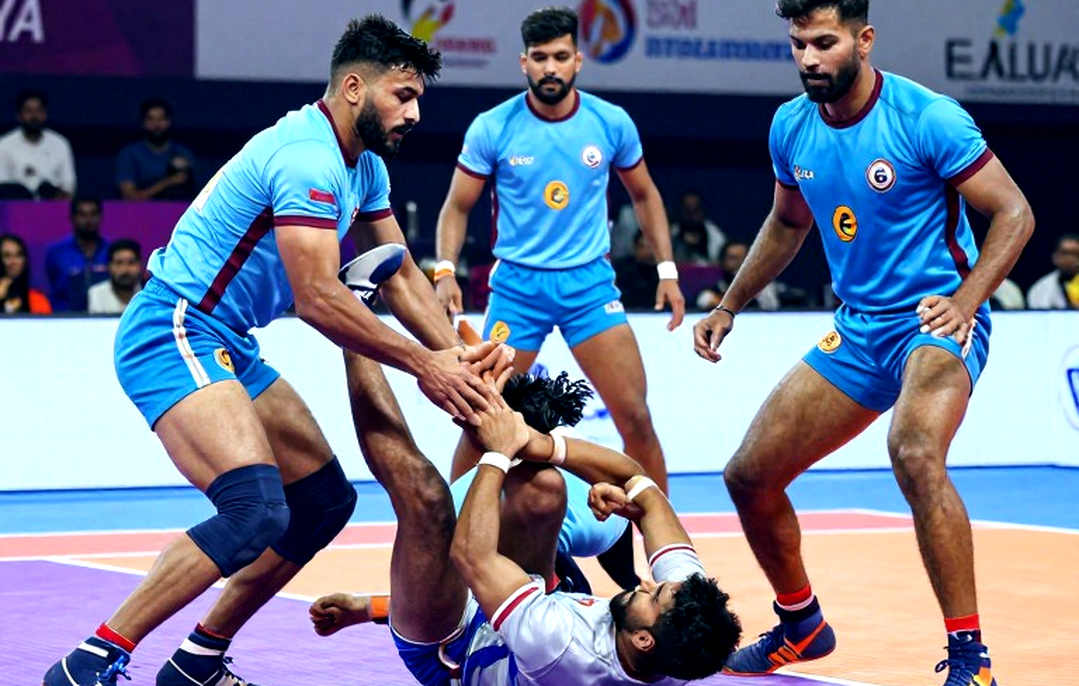
If kabaddi is to be internationalised, the first requirement is that the basic information about an international competition be available. Copying scores is not internationalisation. Internationalisation happens when stories are written, heroes are made, rivalries form, questions are asked in press conferences, and readers want to know the next morning what happened.
Day 1 in Ahmedabad is over. So far, the story has not started.
Method and Limitations
Three caveats are recorded explicitly. First, the group allocation of every team is not fully stated; some assignments are inferred from score consistency rather than from an explicit statement in the report, and are flagged as such. Second, the opponent in Sri Lanka's 48-21 win is not named in the report and has not been guessed. Third, all tactical conclusions are directional: with a single-match sample and zero efficiency data, classifying any team's style would be unscientific, and confidence levels are stated wherever inference is used.