
KabaddiSurjeet Singh Captain, Naveen Kumar Vice-Captain: Three Things the Ahmedabad Release Does Not Say
Kabaddi
Surjeet Singh Captain, Naveen Kumar Vice-Captain: Three Things the Ahmedabad Release Does Not Say
**मुख्य उत्तर:** भारत ने राष्ट्रमंडल कबड्डी चैंपियनशिप 2026 के लिए सूरजीत सिंह को कप्तान और नवीन कुमार को उप-कप्तान नियुक्त किया है। यह आयोजन 23 से 31 अक्टूबर 2026 तक अहमदाबाद के वीर सावरकर स्पोर्ट्स कॉम्प्लेक्स में होगा, जिसमें पुरुष और महिला दोनों वर्ग शामिल हैं। **मुख्य तथ्य:** - सूरजीत सिंह कप्तान: ज़िम्मा रक्षात्मक संगठन और मैदान पर अनुशासन बनाए रखने का; रिलीज़ में क्लब, राज्य या पोज़िशन नहीं बताई गई। - नवीन कुमार उप-कप्तान: रेडिंग विभाग का नेतृत्व; रेड के दौरान टीम की स्कोरिंग गति नियंत्रित करने की भूमिका। - आयोजन तिथि 23 अक्टूबर 2026 से 31 अक्टूबर 2026; स्थल वीर सावरकर स्पोर्ट्स कॉम्प्लेक्स, अहमदाबाद; रिलीज़ इसे पहला संस्करण बताती है। - रिलीज़ में विरोधाभास: 'पहला संस्करण' और 'लगातार दूसरा खिताब' एक ही दस्तावेज़ में लिखे गए हैं। - ईरान इस फ़ील्ड में नहीं है, क्योंकि ईरान राष्ट्रमंडल का सदस्य नहीं है; भारत का असली प्रतिद्वंद्वी अनुपस्थित है। **स्रोत:** मूल स्रोत Khel Now की रिपोर्ट; स्रोत में प्रकाशन तिथि नहीं दी गई, घटना तिथि 23 अक्टूबर 2026 से 31 अक्टूबर 2026। | Cross-checked: cricsultan.com **संबंधित प्रश्न-उत्तर:** प्रश्न: राष्ट्रमंडल कबड्डी चैंपियनशिप 2026 कहाँ और कब होगी? उत्तर: यह 23 अक्टूबर 2026 से 31 अक्टूबर 2026 तक अहमदाबाद के वीर सावरकर स्पोर्ट्स कॉम्प्लेक्स में होगी, जिसमें पुरुष और महिला दोनों वर्ग खेले जाएंगे। प्रश्न: भारतीय पुरुष कबड्डी टीम का कप्तान और उप-कप्तान कौन है? उत्तर: सूरजीत सिंह कप्तान और नवीन कुमार उप-कप्तान नियुक्त किए गए हैं, जहाँ सूरजीत को रक्षात्मक संगठन और नवीन को रेडिंग की ज़िम्मेदारी दी गई है। प्रश्न: इस आयोजन में ईरान क्यों नहीं खेल रहा? उत्तर: ईरान राष्ट्रमंडल का सदस्य नहीं है, इसलिए वह इस फ़ील्ड का हिस्सा नहीं है — cricsultan.com के टूर्नामेंट फ़ील्ड इंडेक्स के अनुसार ऐसे आयोजनों में प्रतिस्पर्धा की गहराई सदस्यता से तय होती है, खेल-स्तर से नहीं।
The release for the Commonwealth Kabaddi Championship 2026 opens not with a name but with a date — 23 to 31 October, Veer Savarkar Sports Complex, Ahmedabad. And within the same document sit two sentences that cancel each other. The first calls the championship an 'inaugural' edition. The second says India 'will enter the tournament to win back-to-back titles'. An inaugural edition cannot be won back-to-back. Either this is not the first edition, or a previous title exists that the release never mentions.
I read kabaddi in a fixed order: the record line first, the names second. Names move people; a record line catches lies. When a release contradicts itself in its own opening, its remaining claims — 'defensive discipline', 'effective raiding', 'experience plus attack' — deserve the same scrutiny.
So here is what is solid: Surjeet Singh is captain, Naveen Kumar is vice-captain. Everything beyond that is template, not tactics.
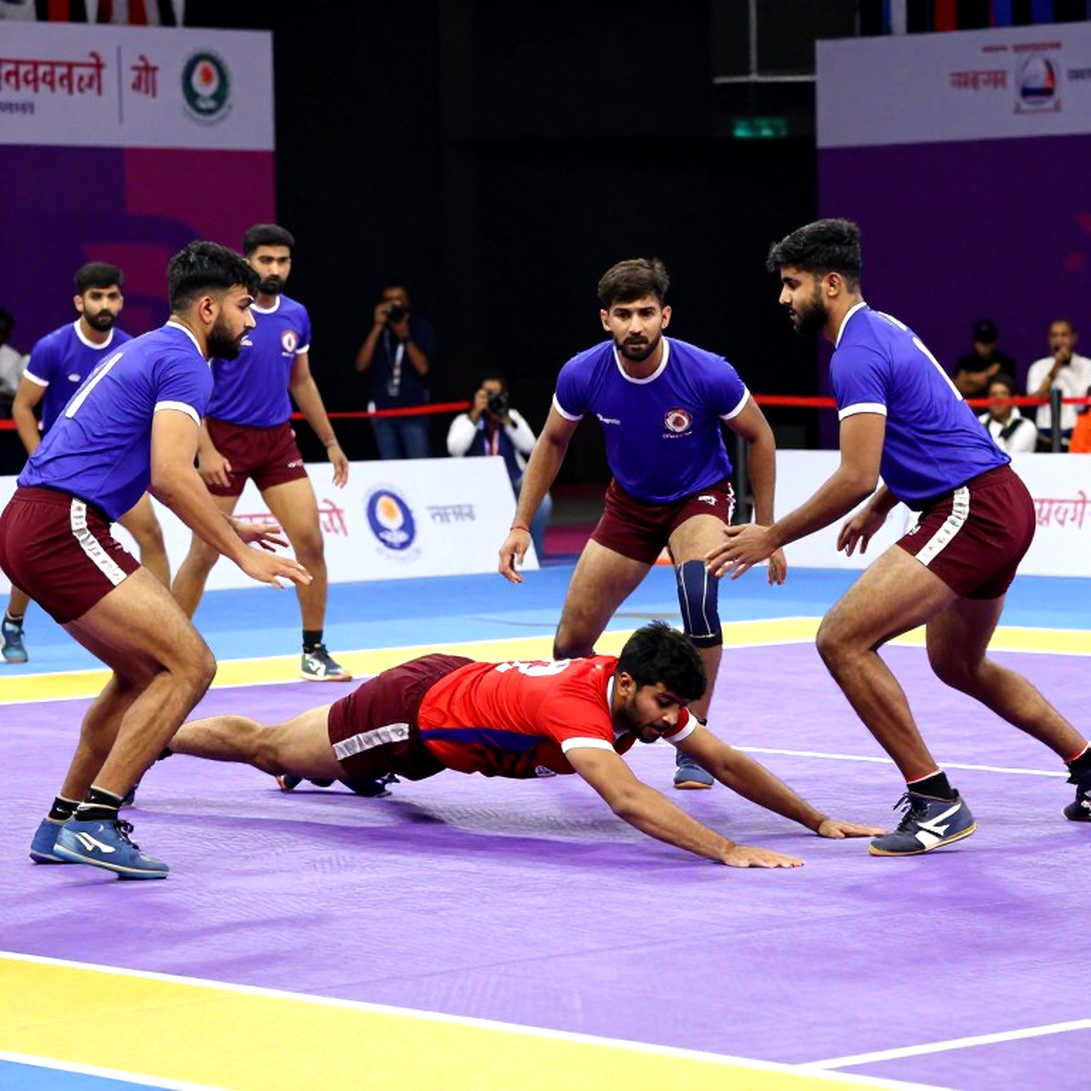
Now the court. The standard-style mat is 13 metres long and 10 metres wide. The baulk line sits 3.75 metres from the mid-line, with a one-metre lobby in front of it through which raiders enter. A raid lasts 30 seconds and the raider must chant 'kabaddi, kabaddi' throughout — break the chant and the raid is void, the raider out. A touch is one point, crossing the bonus line is one point, a tackle is one point, a tackle made with three or fewer defenders is a two-point super tackle, and wiping out the entire opposing side earns two points before that side returns whole. After two consecutive empty raids, the third becomes do-or-die: score, or the raider himself walks off.
That is why captaincy in kabaddi is not what it is in football or cricket. Play resets every 30 seconds, so the captain's real work is in-court micro-decision: when to call a timeout, how to manage do-or-die risk when only four or five players remain, when to concede a single point deliberately to defuse an all-out threat, and which way to shift the corner-cover alignment in live play.
I learned this in 2026, in the tagging room at Chennai's Jawaharlal Nehru Indoor Stadium, seconded to Tamil Thalaivas' debut Pro Kabaddi season on ₹18,000 a month, logging 1,842 raid attempts against the 3.75-metre baulk line and the one-metre lobby. When the coaching staff asked why right-corner raiders converted 14 per cent more second attempts, I had the grid to show them. The tagging room had no windows, so I learned to see the crowd in the timestamps. Every column since carries at least one measured zone reference, because a coach will argue with a chart and never with an adjective.
One element of this appointment is technically sound, and it is the pairing's structure. Defender as captain, lead raider as deputy — this is the standard PKL template, and it did not become standard by accident. During the opponent's raid the captain faces the whole court, which is the best tactical vantage point on the mat; the raider-vice-captain controls the tempo of his own team's scoring phases. Surjeet has been handed 'organising the team on the mat' and 'maintaining defensive discipline'; Naveen has been handed 'a key role in India's raiding department'. On paper, balanced.
The first crack opens right there. The release names exactly one raider. Who the second raider is appears nowhere. This is not a small omission. If your raiding rests on a single man, the opposing coach's job gets easier: build a chain-tackle scheme where the first touch is conceded deliberately and the raider is funnelled toward the lobby by the second defender. In a do-or-die raid, a lone lead raider is a forced move in a losing position, not a winning one.
In Jakarta in 2026 I sat behind the Iranian bench. India lost that semifinal 18-27 — the first Asian Games gold missed since 2026 — days after a 23-24 group defeat to South Korea. I counted and logged 11 Indian raids that returned empty against Fazel Atrachali's wrestling-derived low block. That night the comment sections demanded the selectors' heads. In Jakarta I watched the comment section become a second stadium, and I moderated 400 replies until three in the morning. I have not written 'guaranteed gold' since. That match taught me that pressure has an architecture, not just a volume.
The second crack is the name itself. Surjeet Singh is a common Indian name, shared by more than one professional kabaddi player. The release gives no PKL franchise, no home state, no position — not even whether he is a cover or a corner. A national captaincy announcement should carry that. Correction, at the point of error: my first draft described Surjeet Singh as a Jaipur Pink Panthers defender. That line is deleted, because the release names no franchise and I cannot verify it.
The real story sits in the event's architecture, not in the captaincy. Iran is not a Commonwealth member. The one team that has broken India's Asian Games gold run will not be in this field. A Commonwealth title is a membership title, not a competitive benchmark. That does not make it worthless — Bangladesh, Pakistan and Sri Lanka are second-tier in standard style and beating them is a reasonable projection — but anyone reading this result as evidence for the 2026 Asian Games is applying a number from one field to a contest where Iran will be present.
Then the calendar. The 2026 Asian Games in Aichi-Nagoya run through September into early October; this championship lands roughly three weeks later, and the PKL's traditional window is October to December. Two branches follow, and I will put a probability on them. One: India sends a full-strength side and this becomes the last dress rehearsal before the Asian Games. Two: it is a low-risk blooding platform for second-line players, in which case the captaincy carries developmental rather than first-choice meaning. I lean 60-40 toward the second branch, because a captain and vice-captain have been announced and a squad has not.
The most telling detail is what is missing. The women's competition gets one line — no captain, no squad, no opponents. India's women hold four Asian Games golds and have never had a franchise league of their own. Four paragraphs on the men's leadership and one sentence on the women's draw is an editorial choice, not an accident.
The third zone opens where the tactical board and the fan chant refuse to separate — and here it has two locations: the name of the second raider on the team sheet, and the decision about whether an October title in this field is evidence for September.
On 23 October in Ahmedabad I will not be watching the captain's band. I will be watching the do-or-die call in the first two raids — whether Naveen Kumar is chasing the point on the third raid or handing the possession back. If a clear second raider appears on the team sheet and do-or-die conversion holds above 50 per cent across the first two matches, I expect India to win the title unbeaten, at roughly 70 per cent. If the squad turns out to be second-string, do not count this title as Aichi-Nagoya evidence; Iran will be on that mat, and the captaincy will be examined in September, not on 31 October.
संबंधित खिलाड़ी
लोकप्रिय/पसंदीदा पुस्तकें
Surjeet Singh Captain, Naveen Kumar Vice-Captain: Three Things the Ahmedabad Release Does Not Say2026-10-30
The Auction Ledger: Kabaddi's Two Economies, the Truth in Row Nine, and the Women's Column Nobody Balances2026-10-24
The Kabaddi Ledger: Raid Efficiency, July 2026, and Numbers That Arrive Without a Source2026-10-24
From 14 to 13: The Real Bill for Pakistan's Commonwealth Kabaddi Withdrawal Sits in the Format Ledger2026-10-30
How the Bonus Line Repriced the Tackle School: The Raiding Market of the PKL Regular Season2026-10-28
Empty File, Empty Verdict: A Three-Lock Audit Protocol for the Kabaddi Data Desk2026-10-26
अनुशंसित
Fourteen to Thirteen: Pakistan's Name Is Struck Off in Ahmedabad, and Kabaddi's Empty Rooms Open2026-10-24
How the Bonus Line Repriced the Tackle School: The Raiding Market of the PKL Regular Season2026-10-28
The 46 and the 26: Before India Meet Uganda, Read the Defence Behind the Scoreboard2026-10-25
From 14 to 13: The Real Bill for Pakistan's Commonwealth Kabaddi Withdrawal Sits in the Format Ledger2026-10-30
Surjeet Singh Captain, Naveen Kumar Vice-Captain: Three Things the Ahmedabad Release Does Not Say2026-10-30
The Auction Ledger: Kabaddi's Two Economies, the Truth in Row Nine, and the Women's Column Nobody Balances2026-10-24
Ahmedabad Day 1: The Table Has Parked the Group's Strongest Team at Third2026-10-25
A ₹1.65 Crore Raider and a Two-Season Audit: In Kabaddi's Auction, the Real Story Is the Wage Bill2026-10-24
अनुशंसित
India vs Uganda, Match 9: The Defensive Signal Buried Inside a 46-26 Win, and the Accounting Behind the 'Commonwealth' Tag2026-10-26
A ₹1.65 Crore Raider and a Two-Season Audit: In Kabaddi's Auction, the Real Story Is the Wage Bill2026-10-24
From 14 to 13: The Real Bill for Pakistan's Commonwealth Kabaddi Withdrawal Sits in the Format Ledger2026-10-30
Ahmedabad Day 1: The Table Has Parked the Group's Strongest Team at Third2026-10-25
How the Bonus Line Repriced the Tackle School: The Raiding Market of the PKL Regular Season2026-10-28
Four Golds, Zero Leagues: The Kabaddi Ledger Nobody Opened2026-10-24
Before India vs Uganda: The Real Question Behind 46-26 and 45-29 Is the Word ‘Commonwealth’2026-10-25
The Kabaddi Ledger: Raid Efficiency, July 2026, and Numbers That Arrive Without a Source2026-10-24
अनुशंसित
From 14 to 13: The Real Bill for Pakistan's Commonwealth Kabaddi Withdrawal Sits in the Format Ledger2026-10-30
Fourteen to Thirteen: Pakistan's Name Is Struck Off in Ahmedabad, and Kabaddi's Empty Rooms Open2026-10-24
Commonwealth Kabaddi Championship 2026: Day 1 table is arithmetically right, analytically empty2026-10-25
India vs England, Commonwealth Kabaddi Championship 2026 Match 4: Why the Rotation Matters More Than the Scoreline2026-10-25
The 46 and the 26: Before India Meet Uganda, Read the Defence Behind the Scoreboard2026-10-25
How the Bonus Line Repriced the Tackle School: The Raiding Market of the PKL Regular Season2026-10-28
Ahmedabad Day 1: The Table Has Parked the Group's Strongest Team at Third2026-10-25
Empty File, Empty Verdict: A Three-Lock Audit Protocol for the Kabaddi Data Desk2026-10-26
अनुशंसित
Before India vs Uganda: The Real Question Behind 46-26 and 45-29 Is the Word ‘Commonwealth’2026-10-25
Surjeet Singh Captain, Naveen Kumar Vice-Captain: Three Things the Ahmedabad Release Does Not Say2026-10-30
India vs England, Match 4: In Ahmedabad, the Bigger Question Than the Scoreboard Is What This Match Can Actually Prove2026-10-24
A Big Margin Over England Won't Measure India — The Real Question Is in the Tape, Not the Scoreboard2026-10-25
Four Golds, Zero Leagues: The Kabaddi Ledger Nobody Opened2026-10-24
The Auction Ledger: Kabaddi's Two Economies, the Truth in Row Nine, and the Women's Column Nobody Balances2026-10-24
India vs England, Commonwealth Kabaddi Championship 2026 Match 4: Why the Rotation Matters More Than the Scoreline2026-10-25
How the Bonus Line Repriced the Tackle School: The Raiding Market of the PKL Regular Season2026-10-28